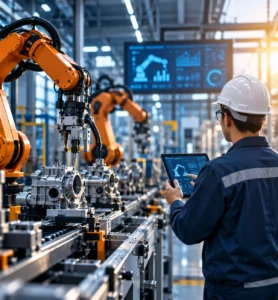
Why OT/IT Integration Matters for Industrial Organizations
Industrial organizations operate in an environment where operational systems and business systems must work together to support reliable, efficient, and data-driven operations. Production equipment, sensors, PLCs, SCADA platforms, historians, enterprise applications, cloud platforms, and analytics tools all generate valuable information. However, when these systems operate in separate environments, organizations may struggle to turn operational data into meaningful business insights.
This is where OT/IT integration becomes important.
OT/IT integration connects Operational Technology (OT), which monitors and controls physical processes, with Information Technology (IT), which manages enterprise applications, data, communication, and business systems. When designed correctly, this connection can help industrial organizations create a more unified digital environment where operational data can securely move between systems and become useful for engineering, operations, management, analytics, and decision-making.
For organizations pursuing industrial digital transformation, OT/IT integration is increasingly becoming an important part of building a connected and scalable technology environment.
What Is OT/IT Integration?
OT refers to the technologies used to monitor, control, and operate physical assets and industrial processes. These technologies can include sensors, programmable logic controllers (PLCs), distributed control systems, SCADA platforms, industrial networks, historians, and other operational systems.
IT focuses on computing, enterprise applications, data platforms, cloud infrastructure, cybersecurity, communication, and business information systems.
Historically, OT and IT environments were often designed and managed separately. OT systems prioritized availability, reliability, and real-time operational control, while IT systems focused on data processing, enterprise applications, communication, and business workflows.
Modern industrial environments increasingly require these two worlds to work together.
Effective OT/IT integration creates secure connections between operational systems and enterprise technology, allowing organizations to collect, standardize, transfer, analyze, and use operational data across different business functions.
Why Is OT/IT Integration Important?
Industrial organizations generate enormous volumes of operational data every day. The challenge is not simply collecting that data. The real challenge is making the data accessible, reliable, secure, and useful.
Without integration, important information may remain isolated inside individual systems.
For example, a manufacturing facility may have production data in a SCADA system, maintenance information in an asset management platform, financial information in an ERP system, and business reporting in a separate analytics platform. If these systems cannot communicate effectively, teams may have to manually combine information before they can understand what is happening across the operation.
OT/IT integration can help create a connected information environment where operational and business data can work together.
1. Creates Better Operational Visibility
Industrial organizations need visibility into equipment, production processes, energy consumption, asset performance, and operational conditions.
When OT systems are connected with appropriate IT and data platforms, organizations can bring information from multiple sources into centralized dashboards and analytics environments.
This can help teams understand:
-
Equipment performance
-
Production conditions
-
Asset availability
-
Energy consumption
-
Process abnormalities
-
Maintenance requirements
-
Operational trends
-
Performance across multiple sites
Instead of relying on isolated systems, teams can access a broader view of operations.
For renewable energy organizations, for example, connecting SCADA data with analytics and cloud platforms can provide centralized visibility across wind, solar, battery storage, and hybrid assets.
2. Turns Industrial Data Into Business Insights
Collecting industrial data is only the beginning.
The value of operational data increases when organizations can combine it with other information and use it for analysis.
A well-designed industrial data integration strategy can connect operational information with enterprise data, allowing organizations to analyze relationships between equipment performance, production, maintenance, costs, and business outcomes.
This creates opportunities for:
-
Real-time analytics
-
Historical trend analysis
-
Performance benchmarking
-
Predictive analytics
-
Anomaly detection
-
Operational reporting
-
Business intelligence
-
AI-driven insights
Integrow’s data management services focus on connecting data across platforms and sources while supporting data architecture, integration, quality, accessibility, and lifecycle management.
The objective is not simply to move data from one system to another. The objective is to create a reliable data foundation that can support better decisions.
3. Reduces Data Silos
Data silos are a common challenge in complex industrial environments.
Different departments may use different systems and maintain separate datasets. Operations may work with SCADA information, maintenance teams may use asset management software, finance teams may depend on ERP systems, and executives may rely on business intelligence dashboards.
When these systems are disconnected, organizations can experience:
-
Duplicate data
-
Inconsistent information
-
Manual reporting
-
Delayed decision-making
-
Limited visibility
-
Difficult data reconciliation
-
Increased operational complexity
OT/IT integration can help break down these silos by establishing controlled data flows between systems.
This allows organizations to create a more connected information environment without necessarily replacing every existing platform.
4. Supports Real-Time Decision-Making
Industrial operations often require decisions based on current conditions.
A production issue, equipment abnormality, energy loss, or unexpected process change can have operational and financial consequences.
Connecting OT systems with modern data and analytics platforms can make relevant operational information available to the people and applications that need it.
For example, real-time operational data can be used to identify abnormal equipment behavior, monitor production performance, or trigger alerts when predefined conditions occur.
This can help organizations move from purely reactive decision-making toward more proactive operational management.
5. Enables Predictive Maintenance
Traditional maintenance strategies often rely on fixed schedules or responses to equipment failures.
With connected operational data, organizations can analyze equipment behavior over time and identify patterns that may indicate potential problems.
Data from sensors, SCADA systems, historians, and asset management platforms can provide valuable information for predictive maintenance initiatives.
Analytics and AI models can potentially help identify:
-
Equipment degradation
-
Abnormal operating patterns
-
Repeated failures
-
Performance changes
-
Maintenance indicators
-
Potential failure conditions
Integrow’s Smart Energy solutions, for example, include predictive maintenance capabilities designed to identify early signs of equipment failure and support maintenance planning.
The quality and accessibility of the underlying operational data remain critical to the success of these initiatives.
6. Improves Industrial Analytics
Industrial organizations need more than raw operational data. They need context.
A temperature reading, production value, energy measurement, or equipment status becomes more useful when it can be analyzed alongside other relevant information.
OT/IT integration creates opportunities to combine operational data with enterprise and contextual data.
This can support:
-
Production analytics
-
Asset performance analysis
-
Energy analytics
-
Quality analysis
-
Maintenance analytics
-
Operational KPIs
-
Portfolio-level reporting
-
Executive dashboards
Organizations can then move from simply monitoring individual systems toward understanding performance across the wider business.
7. Supports Cloud Transformation
Cloud platforms provide organizations with scalable infrastructure for data storage, analytics, applications, reporting, and collaboration.
However, moving industrial data to the cloud requires careful architecture.
Industrial organizations cannot simply connect every operational system directly to the internet. OT environments have unique reliability, security, latency, and availability requirements.
A properly designed architecture can establish controlled pathways between OT environments, intermediate systems, enterprise applications, and cloud platforms.
Integrow’s Smart Energy architecture, for example, includes OT/IT integration with network segmentation and DMZ architecture, along with cloud deployment, role-based access controls, zero-trust principles, and high-availability considerations.
This type of architecture helps organizations modernize their technology environment while considering the operational requirements of industrial systems.
8. Strengthens Data Management
OT/IT integration creates another important requirement: organizations need to manage the data that moves between systems.
Data needs to be accurate, consistent, accessible, secure, and understandable.
Without appropriate data management, integration can simply move inconsistent information from one system into another.
A strong data management approach can address areas such as:
-
Data architecture
-
Data integration
-
Data quality
-
Metadata management
-
Data storage
-
Data lifecycle management
-
Data accessibility
-
Master data management
For industrial organizations, this becomes particularly important when data from multiple facilities, assets, vendors, or operational platforms needs to be standardized.
9. Creates a Foundation for AI
Artificial intelligence depends heavily on data.
Industrial organizations may want to use AI for predictive maintenance, anomaly detection, energy optimization, forecasting, asset performance, or operational intelligence.
However, AI systems require reliable and relevant data.
If operational data is fragmented, inconsistent, poorly documented, or difficult to access, developing useful AI applications becomes more challenging.
OT/IT integration can help create the data connectivity required to support advanced analytics and AI initiatives.
Integrow’s approach to Smart Energy combines connected operational systems, unified data, analytics, AI, and managed services as part of an end-to-end digital model.
10. Helps Organizations Scale Across Multiple Sites
Large industrial organizations often operate multiple plants, facilities, energy assets, or production locations.
Each site may have different equipment, vendors, legacy systems, and operational processes.
This creates significant challenges when organizations attempt to establish centralized visibility.
A scalable OT/IT architecture can help standardize data collection and integration while allowing individual sites to continue using their existing operational systems.
This is particularly valuable for organizations managing distributed assets.
For example, Integrow’s wind energy solutions focus on bringing turbine, substation, and site-level data together into a centralized operational view while supporting existing SCADA systems and OEM data feeds.
OT/IT Integration Does Not Always Mean Replacing Existing Systems
One common misconception is that industrial organizations need to replace their existing OT platforms before implementing digital transformation.
In many cases, integration can be designed around the existing technology environment.
A platform-agnostic approach can allow organizations to connect existing SCADA platforms, OEM systems, asset management platforms, enterprise systems, cloud platforms, and analytics environments.
This can reduce the disruption associated with large-scale technology replacement projects.
Integrow describes its Smart Energy architecture as platform-agnostic, with support for existing SCADA platforms, asset management systems, cloud and analytics platforms, and enterprise systems.
The appropriate strategy depends on the organization’s existing architecture, operational requirements, security policies, data requirements, and long-term transformation goals.
Security Must Be Part of OT/IT Integration
Connecting OT and IT environments also introduces security considerations.
Industrial control environments have different requirements from traditional enterprise IT environments. Availability, safety, reliability, access control, network segmentation, monitoring, and controlled connectivity can all be important considerations.
An OT/IT integration strategy should therefore include security from the architecture stage rather than treating cybersecurity as an afterthought.
Important considerations can include:
-
Network segmentation
-
Secure remote access
-
Role-based access control
-
Identity management
-
Monitoring and logging
-
Secure data transfer
-
Vulnerability management
-
Incident response
-
Backup and disaster recovery
-
Appropriate industrial cybersecurity standards
The exact controls required will depend on the industry, infrastructure, regulatory environment, and operational risk profile.
What Does a Modern OT/IT Architecture Look Like?
A modern industrial technology environment can include several layers.
Field and Control Layer
This layer includes sensors, machines, PLCs, controllers, meters, and other equipment that generate operational information.
OT Layer
SCADA systems, historians, control systems, industrial applications, and other operational platforms collect and manage information from physical assets.
Integration and Data Layer
Integration platforms, data pipelines, APIs, data historians, data lakes, and other services help move and organize information between operational and enterprise environments.
IT and Enterprise Layer
ERP, CRM, asset management, business applications, reporting platforms, and other enterprise systems consume and contribute business information.
Analytics and AI Layer
Business intelligence, advanced analytics, machine learning, predictive models, and AI applications use integrated information to generate insights.
Cloud Layer
Cloud infrastructure can provide scalable storage, computing, analytics, application hosting, and enterprise connectivity.
The architecture should be designed around the organization’s specific operational and business requirements rather than following a one-size-fits-all model.
Common Challenges With OT/IT Integration
Although OT/IT integration can create significant opportunities, implementation requires careful planning.
Legacy Systems
Many industrial environments contain equipment and applications that were designed before modern cloud and data architectures became common.
Integration strategies must account for these systems without unnecessarily disrupting operations.
Data Quality
Poor-quality operational data can reduce the value of analytics and reporting.
Organizations should establish processes for data validation, standardization, monitoring, and governance.
Cybersecurity
Connecting previously isolated systems can increase the importance of cybersecurity controls.
Security architecture should be incorporated into the integration design from the beginning.
Different Technology Standards
Industrial organizations often operate equipment from multiple vendors.
A flexible integration architecture can help manage differences between systems and data formats.
Organizational Silos
Technology integration alone does not eliminate organizational barriers.
Operations, IT, engineering, data teams, cybersecurity teams, and business stakeholders need to work together around shared objectives.
How Organizations Can Start an OT/IT Integration Strategy
A successful integration initiative does not have to begin with a massive technology replacement project.
Organizations can start by understanding their current environment.
Step 1: Map Existing Systems
Identify the organization’s OT systems, IT systems, data sources, applications, interfaces, and dependencies.
Step 2: Identify Data Flows
Determine where operational data is generated, where it is stored, how it moves, and who needs access to it.
Step 3: Define Business Objectives
Integration should support measurable business and operational objectives.
These might include improving asset visibility, reducing reporting time, supporting predictive maintenance, improving production analytics, or enabling centralized monitoring.
Step 4: Establish Security Requirements
Define access controls, segmentation, monitoring, authentication, data protection, and other security requirements before connecting systems.
Step 5: Prioritize High-Value Use Cases
Start with use cases where integrated data can provide clear operational or business value.
Step 6: Build a Scalable Architecture
The architecture should support future systems, additional facilities, new data sources, analytics, and AI applications.
Step 7: Measure and Improve
Integration should be treated as an ongoing capability rather than a one-time project. Organizations can continuously evaluate data quality, system performance, security, user adoption, and business outcomes.
The Future of OT/IT Integration
Industrial organizations are increasingly moving toward connected, data-driven operating environments.
The combination of industrial connectivity, cloud computing, analytics, AI, automation, and modern data architecture is changing how organizations manage physical assets and operational processes.
OT/IT integration provides an important foundation for this transformation.
It allows organizations to connect operational systems with enterprise technology while creating pathways for data to move from physical assets to analytics and ultimately to business decisions.
As industrial organizations adopt more advanced analytics and AI, the importance of reliable data connectivity will continue to grow.
The organizations building scalable and secure data foundations today can create greater flexibility for future digital initiatives.
Final Thoughts
OT/IT integration is more than connecting two technology environments. It is about creating a structured pathway between industrial operations and the information systems that support business decisions.
When implemented thoughtfully, OT/IT integration can help organizations improve operational visibility, reduce data silos, strengthen analytics, support predictive maintenance, enable cloud transformation, and create a foundation for AI.
The most effective approach is not necessarily to replace everything that already exists. Instead, organizations can assess their current environment, identify high-value opportunities, establish secure integration patterns, improve data quality, and build an architecture that can evolve over time.
For industrial organizations pursuing digital transformation, connecting operational technology with enterprise data and analytics can be an important step toward creating a more connected, intelligent, and scalable operation.
If your organization is evaluating its data architecture, integration strategy, or industrial digital transformation roadmap, explore Integrow’s data management solutions to understand how connected data environments can support analytics, reporting, and long-term digital initiatives.